Challenge
Turn sales call analysis into trusted, supportive, and actionable learning moments that fit into salespeople's schedule, to increase company's revenue.
Collaborators
Project manager and CTO
My responsibilities
Product Designer; End-to-End UX & UI Design Process


About Saleso
The platform analyzes sales conversations and turns them into personalized, actionable learning moments.
It's mission is to help salespeople at SMB companies understand what happened on a call, and improve performance to drive growth and revenue.
When I joined the project, Saleso was at an MVP stage with 80+ salespeople across 2 target audience types. I had 8 weeks to hand-off the redesign that would meet the startup's KPIs and serve its users.
My role
Working close to the leadership and helping them rethink sales coaching beyond textual content.
Business goals
Personas
Managers
Visibility into sales calls for tracking performance and skills improvement at scale.
Salespeople
Coaching platform that enhances their skills and confidence to increase impact and growth.
😊
The challenge
The platform demands time and focus that salespeople don’t have.
When Saleso's CEO came in with a pretty straightforward ask - help salespeople learn from their calls, using AI. But once I opened the existing product, it got clearer why this is tricky.
The system was text heavy and without visuals
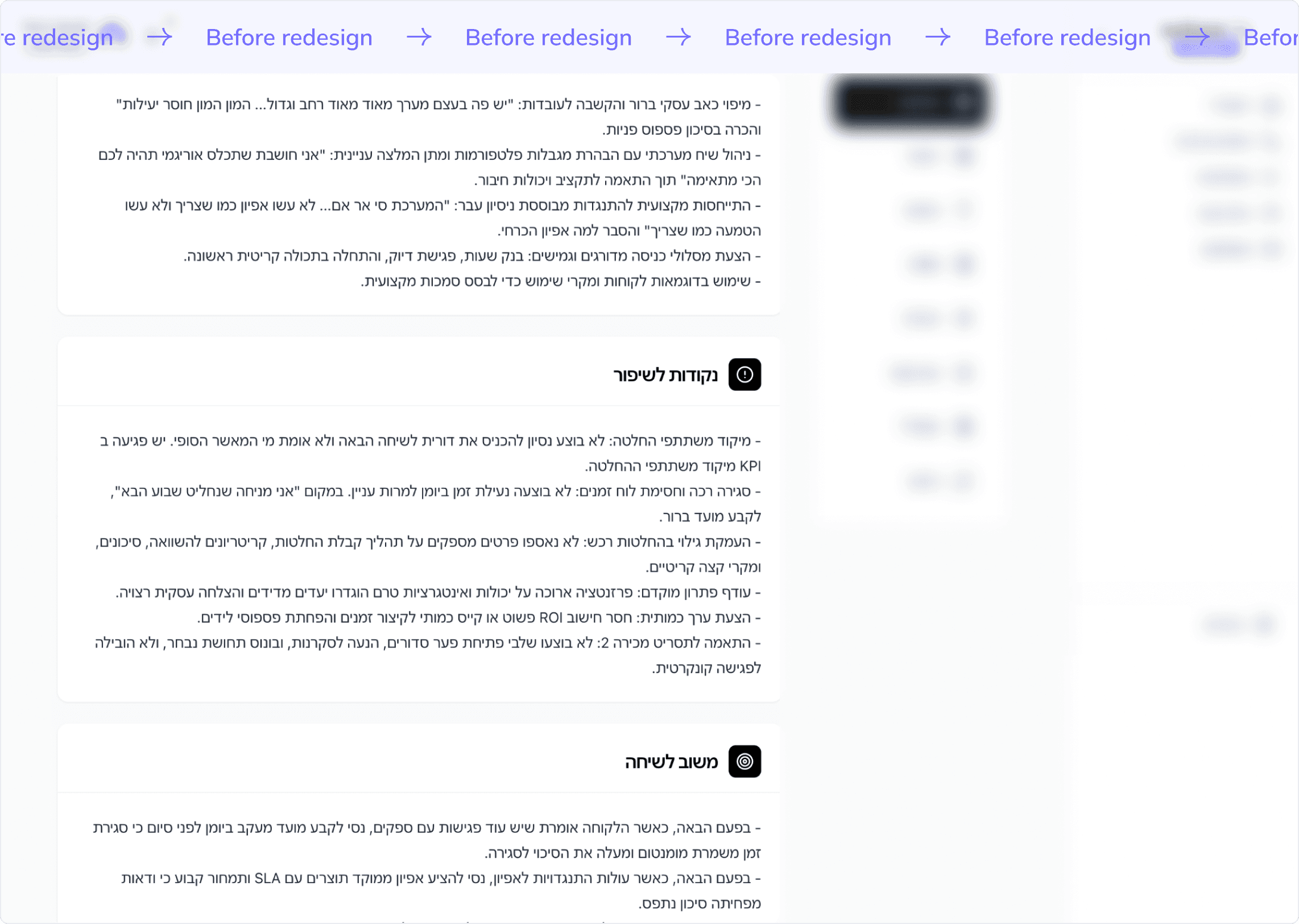
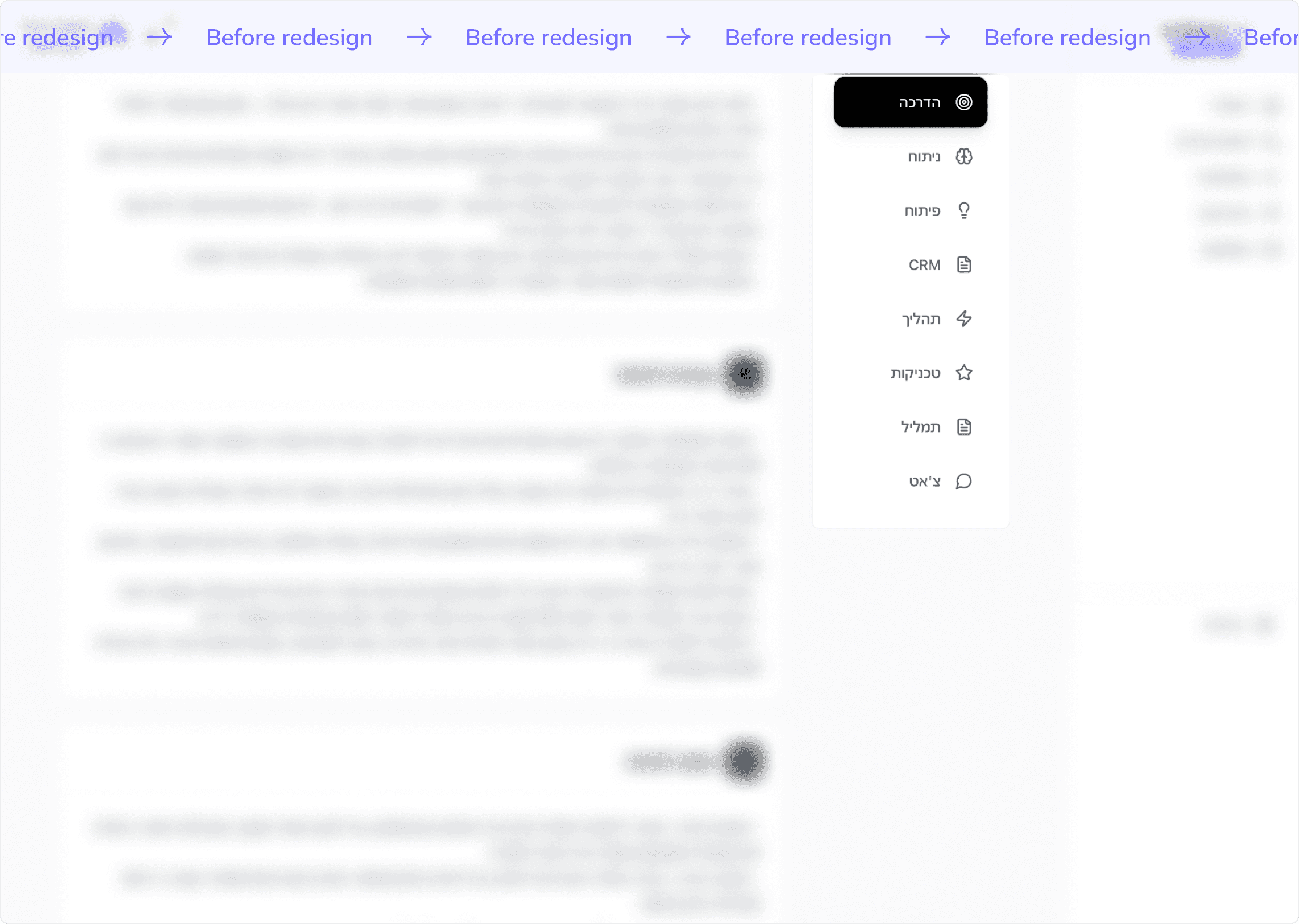
Same hierarchy for all and system-oriented IA
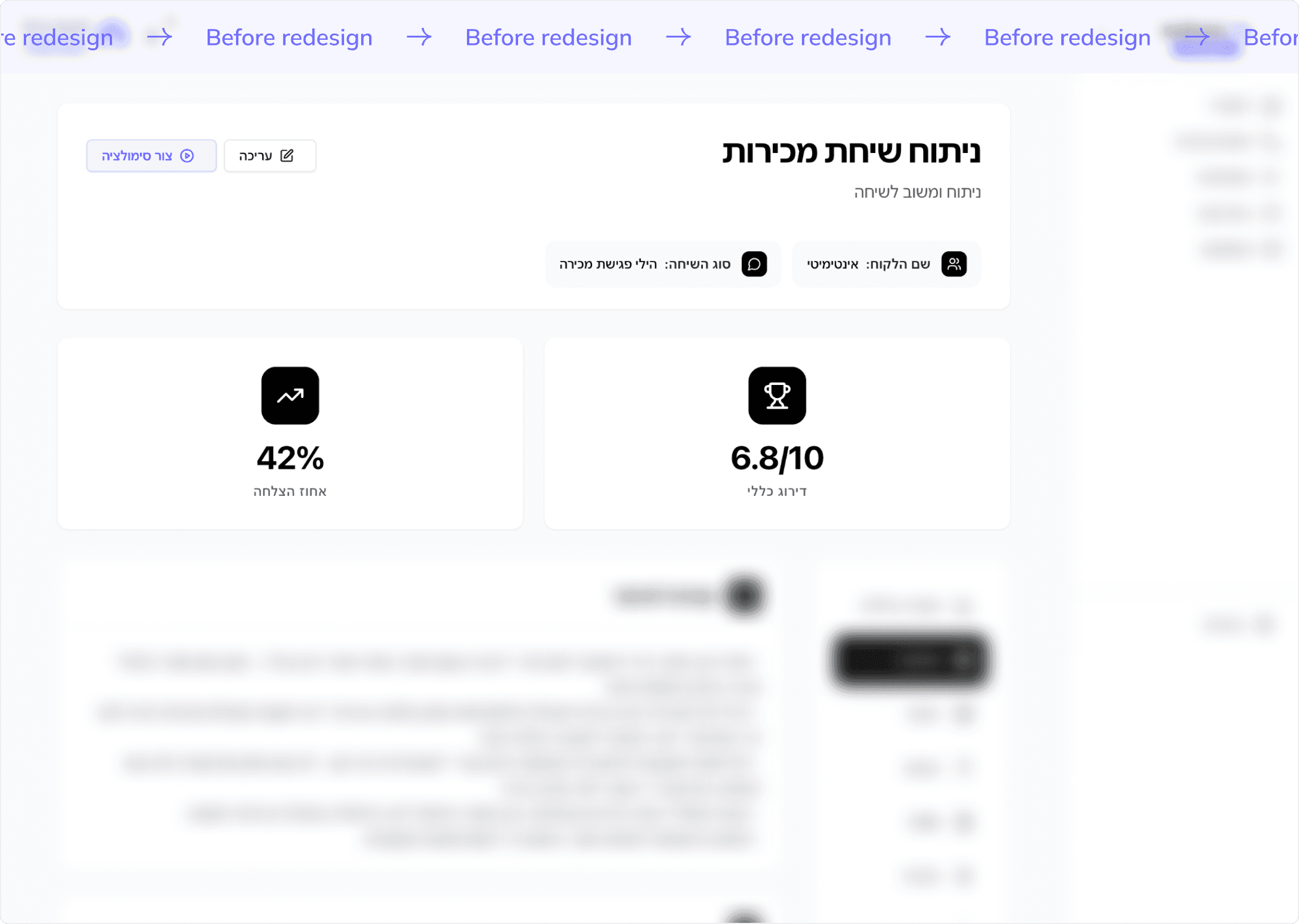
Cold and alienated intonation and no clear actions
Research
Salespeople will receive feedback after every call.
How do we present this in a positive and engaging way?
I had many more questions that motivated me to the research, and these are some of them:
1. How does a salesperson get the main takeaways instantly?
2. What will make them enter the analysis without fear and with a desire to improve?
3. Will salespeople trust an AI telling them how they performed?
Getting more information by conducting guerrilla interviews.
One of the first things I did was meeting with the CEO to get more information - he used to be a salesperson himself, and later a sales coach. I still had gaps, so I arranged 7 quick interviews with salespeople.
The interviews focused on understanding daily experience, especially around the emotional aspect of feedback, learning, and improvement.
It was very insightful, and some things stood out:
Key insights
Salespeople need fast, trustworthy, contextual learning that gives them autonomy over what to improve and when.
It's relationship work. They build emotional connections with prospects and clients.
Time is the biggest constraint - people want clarity fast.
Different sales roles require different skills, so coaching cannot be one-size-fits-all.
Benchmark
Discover similar platforms that present data that salespeople can learn from.
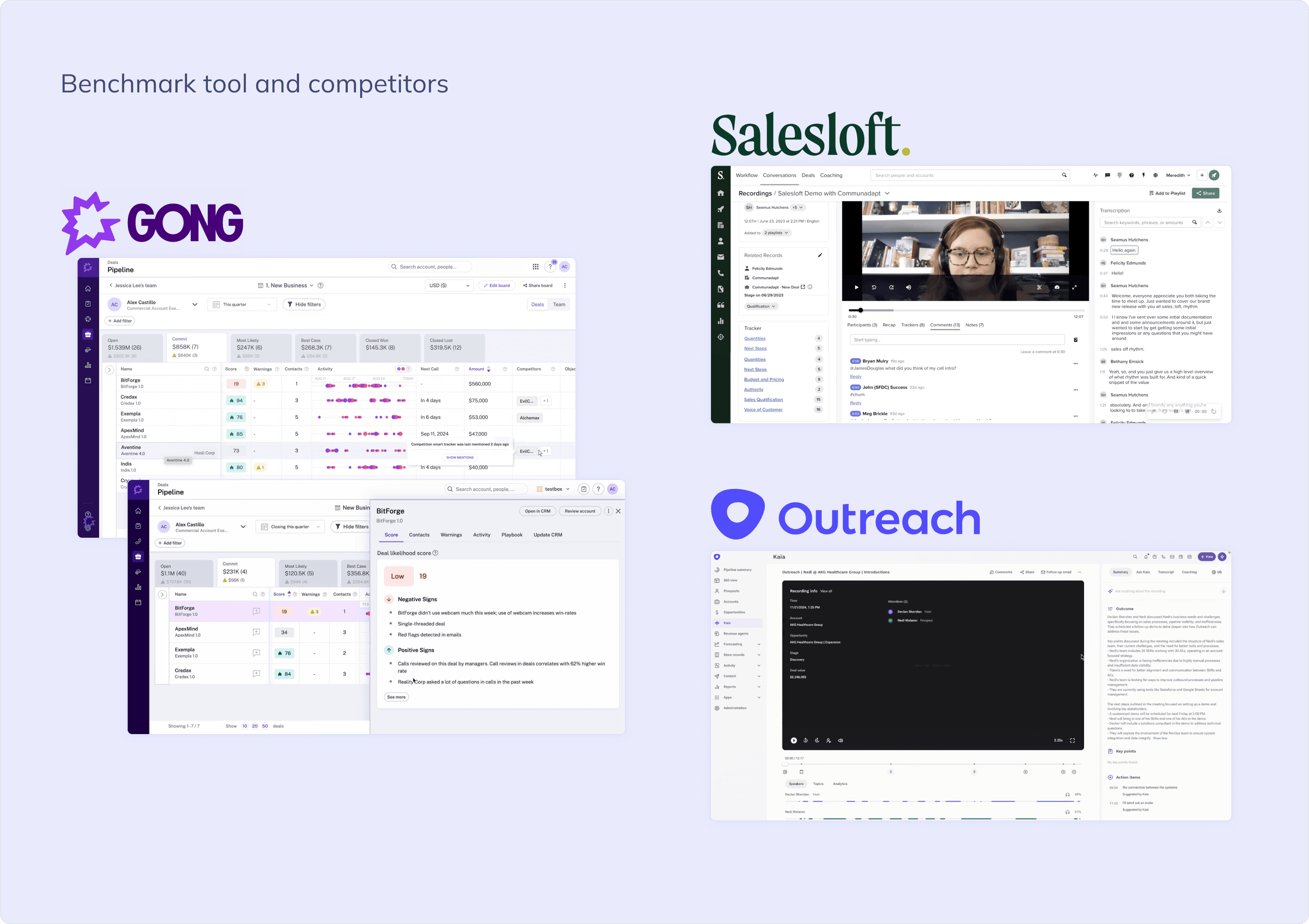
Tools and competitors
The patterns were pretty consistent: dashboards, tables, call recordings, insights and AI chats.
It felt very professional and well thought out, but it didn't feel like a coach as I imagined, especially in a scenario like after an unsuccessful call.

Comparative products
Ideation
With vibe-coding tools I could quickly explore information density, hierarchy, and interaction patterns early.



Ideation
I was looking for the right approach to create a good structure basis. So by using sketching and vibe-coding tools, I tested many ideas and directions. I kept in mind these key aspects:
First thing salespeople see
Way to consume the insights
Practical application of insights

Design approach
The outcomes were very diverse, and I gained a lot of insight from this fast session. I used my insights to narrow it down into a clear structure.
Constructive feedback
Strengths are shown first to increase motivation and competence in receiving feedback.
Navigation across skills
Each skill has its own area, and navigation is done between the tabs.
Content reveals on scroll
Enable autonomy over what to focus on - progressive disclosure.

The solution
Personalized, engaging, and empowering conversation analysis that allows learning moments according to salesperson needs.

Salesperson's strong skills demonstration
Designed to increase confidence before salespeople dive deep into improving skills.
It's proudly displayed, and is used for showing progress and creating opportunities for team challenges.
Sound chart shows the moments where they showed their strengths, giving a sense of credibility and proof of their strengths.
Skills navigation structure, and call recording analysis
A call is analyzed by each skill separately to enable focus and control. The skills are organized by tabs on the right, and arranged by priority that the company sets.
Each skill has an analyzed call recording that shows the relevant parts to improve.
It allows salespeople to learn where they could respond better and explore more suggested responses.

Word charts for building trust and effective future responses
Word charts help recognize clues and respond more effectively to future conversations.
In order to increase credibility and build trust, the chart includes a quote from the conversation that contains the mentioned word.

Turning learning into shared growth
Salespeople can develop contextually relevant skills. By focusing on the value of learning, I gave them an idea of what they would gain.
As an alternative to independent learning, peer learning encourages mutual knowledge sharing. Creates a safe environment for professional growth, and provides meaningfulness in the workplace.

Modal right after a call
Salespeople can choose how to use their time after a call. They can always return to the analysis if they identify a skill they need to improve, but need to move on at the moment.

Outcomes reported after launch
My takeaways
Moving forward

Vibe-coding made UX direction testing dramatically faster
Rapid iterations helped me evaluate information density, hierarchy, and interaction patterns early.

Learning starts with a good feeling
People learn best when feedback feels kind and motivating, especially when learning means facing their mistakes.

Celebrating AI's power
AI can move mountains when it strategically supports user and business goals.
Saleso presents AI at its finest, creating meaningful learning experiences.
😊